3GPP RAN2 #133bis: 6G Control Plane Starts to Narrow Around Simpler SI, Paging and Mobility
3GPP RAN2 #133bis showed 6G RAN2 moving toward simpler system information, single paging, cleaner mobility and unified energy-saving behavior.
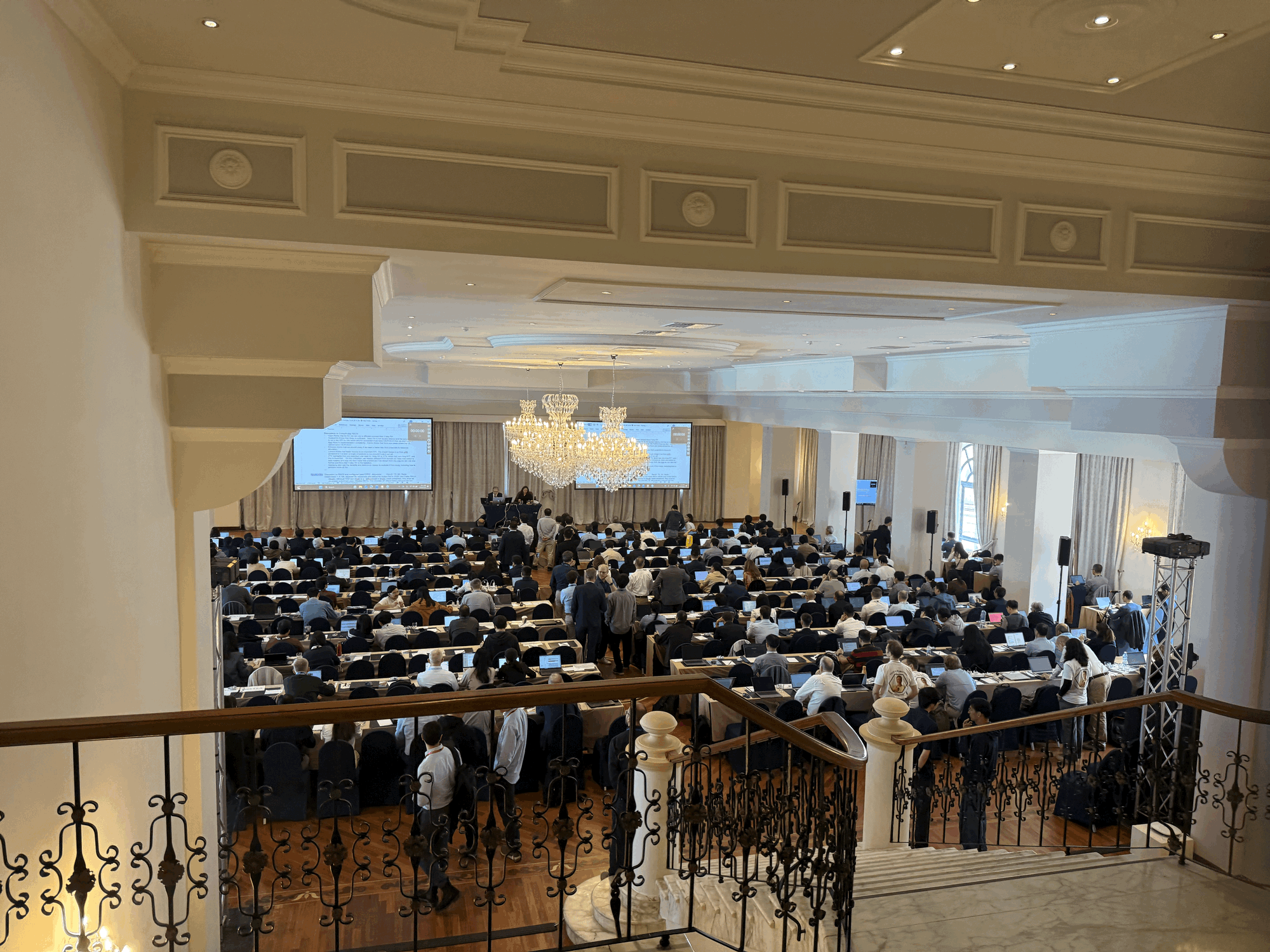
At 3GPP RAN2 #133bis, held in St Julian’s, Malta on 13–17 April 2026, the important story was not a single feature freeze. The useful story was that RAN2’s 6G work started to narrow around a common design theme: simplify the radio protocol stack by reducing duplicated mechanisms in system information, paging, mobility, energy saving and uplink scheduling. The meeting material indicates real progress on the shape of the problems, but many details remain open and depend on SA2, RAN3, RAN1 and SA3 feedback.
RAN2 is the 3GPP working group responsible for the radio-interface protocol architecture and protocol specifications around MAC, RLC, PDCP, SDAP, RRC and radio-resource-management procedures, so these discussions sit close to the practical behavior that vendors and operators will eventually implement in 6G radio access networks. See the official 3GPP RAN2 working group page.
The short version
-
6G system information is moving toward a smaller first acquisition step. RAN2 #133 had already agreed that 6G SIB1 should at least include basic camping information, cell barring information needed for suitability checking, and enough scheduling information to receive the next SIB. The #133bis material brought concrete proposals for SIB1/SIB1x split designs and more compact SI scheduling, but those proposals should not be read as final agreements.
-
Single paging for idle and inactive UEs is one of the highest-value architectural questions. RAN2’s prior preference is a single CN-triggered paging mechanism for idle and inactive states and a single paging area, but the #133bis material still leaves key questions for SA2 and RAN3: where UE AS context can be stored, how it is retrieved, and whether CN can store or assist with UE AS context.
-
Mobility work is shifting from “more handover features” to “less interruption and less wasted preparation.” The #133bis mobility proposals focus on minimizing L2 reset, using partial pre-configuration to reduce reserved-resource waste, improving idle/inactive reselection, and carrying forward NTN-specific mobility work such as satellite switching and GNSS-less operation.
-
Rel-20 LTM dynamic L1 measurement work is real, but the granularity is still unsettled. RAN2 #133 agreed on a two-level framework where RRC pre-configures LTM measurement/reporting configurations and MAC CE selects what the UE applies. The #133bis debate is about whether that MAC CE should operate at report configuration, resource, candidate-cell or finer granularity.
-
Energy efficiency is becoming a cross-state design issue, not just a connected-mode feature. RAN2 #133 identified 5G’s fragmented DRX, LP-WUS and DCP design as a pain point and agreed to study a single discontinuous monitoring framework covering C-DRX without DL WUS, C-DRX with DL WUS, and DL WUS without C-DRX.
-
The meeting also kept Release 20 work moving outside pure 6G. Ambient IoT Phase 2, IoT NTN voice support, AI/ML mobility, AI/ML LCM, SON/MDT, and LTM SCell activation all appear in the #133bis material as active Rel-20 workstreams.
What was 3GPP RAN2 #133bis trying to achieve?
RAN2 #133bis was a Release 20 and 6G working meeting. The agenda allocated time to Rel-20 work items such as Ambient IoT Phase 2, AI/ML for mobility, Mobility Enhancement Phase 5, XR Phase 4, SON/MDT Phase 5, IoT NTN Phase 4, and the 6G Radio study. The same agenda also set the 6G study focus around radio protocol architecture, control plane, user plane, common user/control-plane functions, mobility and ISAC.
The 6G study is captured in the RAN2 part of TR 38.760-2. The #133bis TR material shows that the rapporteur update was not trying to freeze a full architecture. It was restructuring the skeleton TR and adding RAN2 agreements from earlier 6G discussions, including agreements from RAN2 #131bis, #132 and #133.
Answer block: What mattered most at RAN2 #133bis?
The main value of RAN2 #133bis was problem narrowing. RAN2 was not yet finalizing 6G protocols, but the material shows clearer convergence around fewer mechanisms for SI acquisition, paging, mobility, uplink scheduling and energy saving. The practical impact is that 6G RAN2 design is being shaped by a “do not repeat 5G complexity” principle.
Related pages:
Previous analysis of RAN2 #132
Evidence base and caveats
This article is based on the RAN2 #133bis review pack, including the agenda, the RAN2 #133 meeting report, #133bis company contributions, draft liaison material, work-plan material and TR 38.760-2 update material. The uploaded material does not include a final official RAN2 #133bis meeting report. For that reason, I treat #133bis company papers as proposals or discussion material unless the text itself clearly identifies an agreement, outgoing liaison, approved CR, or prior-meeting agreement.
The #133 report is still important evidence because many #133bis contributions explicitly build from RAN2 #133 agreements. The RAN2 #133 report states that #133bis was the next RAN2 meeting and that RAN2 #134 is scheduled for 18–22 May 2026 in Dalian, China.
Methodology used for this post: I prioritized the agenda, official report material, TR/work-plan material, liaison statements, and documents that quote RAN2 agreements. I used company discussion papers to explain technical direction only when they were consistent with the meeting agenda and prior agreements. I did not treat a proposal in a company paper as an agreed RAN2 conclusion.
Main technical progress
1. 6G system information is being pushed toward a smaller SIB1 and more flexible scheduling
System information was one of the clearest examples of the “simplify 6G from day one” theme. RAN2 #133 had already agreed that 6G SIB1 should provide at least three things: basic camping information, cell barring information required for suitability checking, and enough scheduling information to receive at least the next SIB, sometimes discussed as SIB1x. RAN2 also agreed to study splitting other content out of SIB1 and to study flexible SI scheduling based on a window scheme that can transmit SIs in a shorter time period.
In plain terms, SIB1 is the first system-information block that a UE reads after basic cell detection. If SIB1 grows too large, every UE pays the cost during acquisition, even if most UEs do not need every feature-specific field immediately. The #133bis proposals therefore try to keep SIB1 focused on cell suitability and move initial-access, paging, broadcast reception, other SI scheduling, and device/service-specific material into a follow-up SIB such as SIB1x.
Apple’s system-information contribution, R2-2602231, argued for dynamic monitoring windows for on-demand SI, scheduling shorter-periodicity SI before longer-periodicity SI, allowing mixed SI window lengths, improving SI update granularity, and splitting SIB1/SIB1x so that 6G SIB1 carries only the configuration needed for basic camping. Those are proposals in the uploaded material, not final agreements.
Why this matters: SIB1 size and SI scheduling are not cosmetic details. They affect UE acquisition delay, coverage robustness, UE power consumption and network energy consumption. A smaller first acquisition step also makes later 6G features easier to add without forcing every UE to decode every field during initial access.
2. Single paging is becoming the key idle/inactive architecture question
RAN2 has been exploring whether 6G can avoid the duplicated paging structure that 5G created between RRC_IDLE and RRC_INACTIVE. The prior RAN2 #133 position, quoted in the #133bis material, is that RAN2 prefers a single paging mechanism from the UE and network perspective for idle and inactive state, based on CN-triggered paging. RAN2 also prefers a single paging area for both states, but needs SA2 feedback on feasibility.
Single paging means that the network would not maintain one paging model for idle UEs and a separate RAN paging model for inactive UEs. The technical difficulty is not the paging message alone. The hard question is where the UE AS context lives and how quickly a new access node can retrieve it when an inactive UE responds.
The #133bis material identifies two context-storage candidates: UE AS context only in the last RAN node, or UE AS context in the last RAN node and the CN. The material notes that storing context in the CN could reduce resume latency, but also says RAN2 needs SA2 feedback on whether CN storage of UE AS context is feasible.
Answer block: What is the single paging issue in 6G RAN2?
The single paging issue is whether 6G can use one CN-triggered paging model for both idle and inactive UEs. The benefit is simpler UE and network behavior. The unresolved part is UE AS context management: the network must know whether the UE should resume using stored AS context or fall back to a setup procedure.
There is also an identity question. Prior RAN2 #133 material says a single paging ID can be used for CN-triggered paging and there was no motivation at that point to differentiate the UE state in the paging message. For resume, however, the UE ID remains FFS and may differ from the paging ID.
Why this matters: Single paging is not just a power-saving feature. It affects CN/RAN split, inactive-state modelling, resume latency, UE identity design, paging area design and SA2/RAN3 interfaces. If 6G gets this wrong, it risks carrying forward one of the more operationally complex areas of 5G RRC state management.
3. LTM mobility work is focusing on lower interruption without uncontrolled resource reservation
Mobility at #133bis showed a practical shift: RAN2 is not simply looking for another handover variant. The stronger theme is minimizing interruption while avoiding excessive early resource reservation and configuration burden.
Apple’s mobility contribution, R2-2602233, argued that 6G should minimize L2 reset when the anchor node is unchanged. It proposed studying avoidance of MAC reset during intra-node or intra-DU mobility, avoiding DRB PDCP reset during inter-node mobility without UP anchor change, and using CA-like architecture to avoid L2 reset. It also proposed partial pre-configuration, where the network provides only part of the candidate-cell configuration before mobility and provides the remaining lower-layer configuration when or after the UE switches.
LTM, or L1/L2-triggered mobility, is a mobility framework intended to reduce interruption by moving some mobility triggering and execution behavior closer to lower layers. The #133bis material shows that Rel-20 Mobility Enhancement Phase 5 continues to refine LTM, especially SCell activation and dynamic L1 measurement/reporting.
One important Rel-20 topic is dynamic L1 measurement and reporting configuration change for LTM. RAN2 #133 had already agreed on a two-level framework: RRC provides LTM measurement and reporting configuration, while MAC CE indicates which configuration the UE should apply. RAN2 also agreed to introduce an initial state indicator for pre-provisioned RRC configurations.
The #133bis discussion did not fully converge on granularity. Samsung’s R2-2602489 proposed limiting the MAC CE scope to selection of RRC pre-configured L1 measurement/reporting configuration and using at least the LTM report configuration index. Other contributions argued for candidate-cell or resource-based granularity, because report-config granularity may not be flexible enough when the relevant candidate cells change with UE movement.
Why this matters: This is a classic RAN2 trade-off. A coarse MAC CE is simpler, smaller and easier to specify. A finer MAC CE may save UE measurement power and reduce unnecessary reporting, but adds state handling and corner cases after cell switch. The design choice affects UE implementation, inter-node coordination and mobility robustness.
4. Fast ARQ and contention-based uplink are trying to cut avoidable uplink delay
The user-plane discussion is also driven by a 6G simplification objective: avoid slow reactive scheduling when the UE has latency-sensitive uplink traffic. In NR, a UE may need SR, then grant for BSR, then BSR, then grant for data. That sequence is reliable but can add delay before the actual data is transmitted.
RAN2 #133 had already agreed several points on HARQ-assisted faster ARQ. From the RAN2 point of view, an explicit DCI indication is preferred for triggering faster ARQ in UL for a given HARQ process failure. Upon receiving the indication, the UE triggers ARQ retransmission and is not expected to continue HARQ retransmissions after that indication. RAN2 also identified HARQ NACK-to-ACK error as a reliability issue and noted that HARQ reliability is a RAN1 design decision.
The #133bis material also includes draft liaison text asking RAN1 to consider three fast-ARQ scenarios: continuous UL traffic on the current carrier, fast ARQ for the last packet, and fast ARQ retransmission over another carrier. That is useful because a one-bit “HARQ process failed” signal is not enough by itself to define the entire cross-layer behavior.
Open technical questions remain. Several contributions point out that the transmitting RLC entity may not know which RLC PDUs were carried in a failed MAC PDU unless the MAC/RLC mapping is made visible or reconstructed. With multiple AM RLC entities, a simple DCI indication may not identify the RLC entity or sequence numbers that need ARQ retransmission.
Contention-based uplink resources are another possible latency tool. ASUSTeK’s R2-2601937 discussed contention-based UL resources for BSR or other signalling, while other material in the pack proposed 2-step RACH resources dedicated for BSR, improved BSR granularity, and SR configurations associated with buffer-size or delay ranges. These are proposals under study, not final RAN2 decisions.
Why this matters: Fast ARQ and early/fast uplink scheduling are important for XR, mobile AI, gaming, uplink-heavy media and industrial traffic. The difficult part is not proving that lower delay is useful. The difficult part is reducing delay without creating excessive DCI overhead, contention collisions, resource waste or cross-layer complexity.
5. Energy efficiency is moving toward one discontinuous monitoring framework
Energy efficiency was another area where the meeting material showed a strong design philosophy: do not repeat 5G’s accreted set of similar-but-not-identical power-saving features.
RAN2 #133 agreed that only a single DRX configuration is active at a time, identified 5G’s multiple DRX, LP-WUS option 1-1, LP-WUS option 1-2 and DCP options as a pain point, and agreed to study C-DRX without DL WUS, DL WUS together with C-DRX, and DL WUS without C-DRX. The target is a single discontinuous monitoring framework where the UE periodically monitors wake-up signalling and follows defined PDCCH monitoring behavior after wake-up.
Cell DTX/DRX is the network-side part of the same problem. If the network is going to sleep, the UE needs to know when it can transmit in UL, when it may receive DL, and when reference signals or other resources exist. RAN2 #133 therefore agreed to study what the UE needs to know to operate in all RRC states if the network sleeps, including UL resources/timing and DL resources/reference signals.
The #133bis material contains multiple proposals to align Cell DTX/DRX, C-DRX and DL WUS, including proposals that Cell DTX/DRX should apply across all RRC states and that active/inactive periods should be tightly aligned. Those are still proposals, but they reflect a clear direction: 6G energy saving should be designed as a coherent system rather than a sequence of release-by-release patches.
Why this matters: Energy saving mechanisms interact with paging, SI, random access, measurement, mobility and scheduling. A fragmented design can save power in one scenario while creating latency or signalling cost in another. A unified framework is harder to design up front, but easier to deploy and test.
6. Ambient IoT Phase 2 is expanding from indoor inventory toward UE-reader and active-device procedures
Ambient IoT remained a significant Rel-20 workstream. The #133bis material includes Topology 2 discussions where an intermediate UE acts as a reader. In the Rel-20 objective quoted in the pack, the UE reader is an RRC_CONNECTED UE, A-IoT radio resources are valid within the serving cell, and resource allocation to the UE reader is via Uu RRC signalling. The same material notes prior RAN2 agreements that new UL and DL Uu RRC messages are introduced to carry upper-layer data between UE reader and base station over a new SRB, and that RRCReconfiguration can allocate A-IoT resources.
SA2 liaison material also shows that Ambient IoT active-device mobility and power saving require cross-group alignment. SA2 considered DO-A capable device mobility registration, where AIOTF allocates an AIoT Registration Area composed of TAI-like information and the device initiates mobility registration when moving outside that area. SA2 asked whether NG-RAN or a RAN reader can broadcast area information on the AIoT radio interface.
Why this matters: Ambient IoT is no longer just an air-interface curiosity. The active-device and UE-reader cases require RAN2 to define how RRC, resource allocation, reader authorization, mobility, power saving, and upper-layer data transport fit together without overloading either the UE reader or the network.
7. NTN remained active in mobility and NB-IoT voice support
NTN appeared in several parts of the #133bis material: 6G mobility, IoT NTN voice, E-UTRA TN to NR NTN handover, and NTN-related measurement assistance.
For 6G mobility, Apple’s R2-2602233 argued that, assuming different frequencies for different orbits, existing NR NTN mobility design can support NTN-NTN and TN-NTN mobility across different orbits. The same contribution proposed studying NTN-specific satellite switching with the NR NTN satellite-switch-with-resync mechanism as a baseline, and proposed beam/cell-level reference location for GNSS-less operation only for propagation-delay-difference-related functions, not absolute location functions.
IoT NTN Phase 4 also addressed voice over NB-IoT NTN. A draft reply in the pack states that, from a RAN2 point of view, one transmission or retransmission delay over a GEO satellite was assumed to be 1.5 RTT, around 810 ms. It further says voice data mapped to UM DRB may assume an AN-PDB of 1.5 RTT if no retransmission is required for a given BLER, while IMS signalling mapped to AM DRB may require a multiple of 1.5 RTT depending on PELR.
Why this matters: NTN forces RAN2 to be honest about timing. Mechanisms that look acceptable in terrestrial cells can become fragile when RTT, satellite switching, GNSS availability and discontinuous coverage are added.
8. AI/ML LCM and data/model transfer need a more unified 6G framework
The uploaded material shows that RAN2 is already trying to avoid one AI/ML LCM design per use case. ASUSTeK’s R2-2601938 argues that 5G AI/ML LCM has been coupled to legacy feature frameworks, such as CSI or RRM, and that this can create complexity when multiple AI/ML functionalities must share computation, memory or activation state.
Other AI/ML framework material proposes studying a unified framework for capability reporting, applicability reporting, prediction configuration, performance monitoring, data collection, and model transfer. It also raises the question of how multiple AI/ML functionalities can run in parallel and share CPU, accelerator and memory resources.
The model-transfer question remains open. One contribution notes that UE-side AI model download/deployment may involve a UE server as data producer, the UE as data consumer, termination point FFS, relaxed latency, and large data size.
Why this matters: AI/ML can easily become a specification multiplier if every use case gets its own LCM procedures. A reusable framework is more valuable than a highly optimized one-off design, especially while 6G use cases are still being prioritized.
What did not converge yet?
Several high-value topics remain open in the #133bis material.
| Open item | Why it remains open | What to verify next |
|---|---|---|
| Final #133bis agreements | The uploaded pack does not include the final RAN2 #133bis meeting report. | Check the official #133bis report once published. |
| SIB1/SIB1x split | RAN2 has a direction from #133, but exact contents and acquisition behavior are still under study. | Which fields stay in SIB1, which move to SIB1x, and whether SIB1x is considered essential. |
| Single paging | RAN2 preference exists, but SA2/RAN3 feasibility is required. | UE AS context storage, CN visibility of inactive state, paging/resume ID design, and N2/N3 behavior. |
| Dynamic LTM measurement MAC CE | The two-level framework is agreed, but granularity is debated. | Report-config vs resource vs candidate-cell selection, and behavior after LTM cell switch. |
| Fast ARQ | RAN2 has a preferred UL trigger direction, but cross-layer details remain. | RAN1 DCI design, RLC entity/SN identification, last-packet behavior and cross-carrier retransmission. |
| Unified energy framework | RAN2 agrees to study a single discontinuous monitoring framework, but not the final design. | DL WUS design, Cell DTX/DRX interaction, all-state applicability and paging alignment. |
| Ambient IoT active-device behavior | SA2/RAN2/RAN3 dependencies remain. | Registration area broadcast, power-saving mode, UE reader selection and procedure termination. |
| AI/ML model transfer | Scope and architecture are not settled. | Transfer endpoints, trigger conditions, mobility continuity, integrity and whether transfer is standardized. |
| MAC CE security | SA3 has asked RAN2 for assumptions and constraints. | RAN2 response on overhead, ordering, grouping, time-critical MAC CEs and future MAC CE extensibility. |
What to watch next
The next RAN2 meeting to watch is RAN2 #134, scheduled for 18–22 May 2026 in Dalian, China. The RAN2 #133 meeting report and the current 3GPP meeting schedule both identify Dalian as the next RAN2 stop after #133bis. See the official 3GPP meeting calendar.
The most important questions for RAN2 #134 are likely to be:
-
Will SA2 accept the assumptions needed for single CN-triggered paging?
The key question is whether CN can store or assist with UE AS context, and how CN/RAN connection state should behave when a UE enters inactive mode or sub-state. -
Will dynamic LTM measurement configuration converge on report-config, resource, or candidate-cell granularity?
This decision affects MAC CE size, UE measurement power, reporting state, and candidate-cell coordination. -
Can RAN2 and RAN1 make fast ARQ practical without creating a new source of complexity?
DCI signalling may be the right trigger, but RAN2 still needs a clean mapping from failed HARQ process to ARQ retransmission behavior. -
Will SIB1 minimization become a concrete field-level design?
The SIB1/SIB1x split is promising, but RAN2 must still balance acquisition latency, coverage, UE complexity, and system-information update behavior. -
Will the energy-saving framework become truly cross-state?
The hard part is not adding another WUS or DRX option. The hard part is making C-DRX, DL WUS, Cell DTX/DRX, paging, SI and RA work together.
Key terms
| Term | Meaning |
|---|---|
| RAN2 | 3GPP RAN working group responsible for radio-interface protocols and RRC/RRM procedures. |
| RRC | Radio Resource Control, the protocol layer that manages UE connection state, configuration, mobility and system information behavior. |
| SI | System Information, broadcast or on-demand information that UEs need for cell access, reselection, paging and feature operation. |
| SIB1 | The first major system-information block read by a UE; in 6G discussions, RAN2 is studying how to keep it small. |
| SIB1x | Informal placeholder name used in discussions for a follow-up SIB after SIB1. |
| RRC_INACTIVE / inactive sub-state | A UE state or sub-state where UE and network retain context to enable faster transition than full idle setup. |
| UE AS context | Access Stratum context stored for a UE, used for resume and fast transition procedures. |
| PF/PO | Paging Frame and Paging Occasion, the time-domain structure used by UEs to monitor paging. |
| LTM | L1/L2-triggered mobility, a mobility framework intended to reduce interruption by using lower-layer triggering and pre-configuration. |
| MAC CE | MAC Control Element, a compact MAC-layer control message used for fast configuration or status signalling. |
| HARQ / ARQ | Hybrid Automatic Repeat Request and Automatic Repeat Request; retransmission mechanisms at lower and higher layers. |
| Cell DTX/DRX | Network-side discontinuous transmission/reception behavior that creates network sleep opportunities. |
| DL WUS | Downlink Wake-Up Signal, used to reduce unnecessary UE monitoring. |
| A-IoT | Ambient IoT, a 3GPP work area for very low-complexity devices and reader-based communication. |
| NTN | Non-Terrestrial Networks, including satellite-based radio access. |
Key TDocs referenced
The links below point to the verified official 3GPP RAN2 #133bis meeting document folder. Exact per-TDoc Portal links should be verified before publication.
| TDoc | Title | Agenda item | Source | Final status in this draft | Why it matters |
|---|---|---|---|---|---|
| R2-2601401 | Agenda | 2.1 | RAN2 Chair | Agenda material | Defines meeting scope and 6G/R20 agenda structure. |
| R2-2601402 | Report of 3GPP TSG RAN WG2 meeting #133 | 2.2 | ETSI MCC | Prior meeting report, not #133bis final report | Baseline for many #133bis discussions and quoted agreements. |
| R2-2602493 | Work Plan for 6G SI RAN2 | 9.1 | CMCC, NTT DOCOMO, AT&T, Vodafone | Information | Shows the 6G RAN2 study timeline and topic structure. |
| R2-2602619 | TR 38.760-2 Study on 6G Radio RAN2 aspects | 10.1 | CMCC rapporteur | Discussion | Tracks the RAN2 6G study skeleton and prior agreements. |
| R2-2602231 | Views on 6G System Information | 9.3.2.3 | Apple | Discussion/Decision contribution | Provides concrete proposals for SIB1/SIB1x, SI scheduling and on-demand SI. |
| R2-2602232 | Views on 6G Paging | 9.3.2.4 | Apple | Discussion/Decision contribution | Covers single paging, PF/PO distribution, beam-subset paging and paging/resume IDs. |
| R2-2602233 | Views on 6G Mobility | 9.4 | Apple | Discussion/Decision contribution | Frames L2 reset minimization, partial pre-configuration and NTN mobility. |
| R2-2602489 | Support of Dynamic L1 Measurement and Reporting Configuration Change | 8.4.3 | Samsung | Discussion/Decision contribution | Clarifies MAC CE selection scope for Rel-20 LTM dynamic measurement work. |
| R2-2601931 | Discussion on Topology 2 for A-IoT | 8.2.3 | ASUSTeK | Discussion/Decision contribution | Explains UE-reader resource and RRC procedure questions for Ambient IoT Phase 2. |
| R2-2601937 | Discussion on Contention based UL resource | 9.3.1.3.1 | ASUSTeK | Discussion/Decision contribution | Discusses contention-based uplink resources for lower-latency UL scheduling. |
| R2-2601939 | Discussion on energy efficiency | 9.3.3.3 | ASUSTeK | Discussion/Decision contribution | Discusses Cell DTX/DRX, C-DRX and DL WUS interaction. |
| R2-2601427 | LS on MAC CE security | Incoming LS | SA3 | Liaison in | Adds a security dependency for future 6G MAC CE design. |
Conclusion
RAN2 #133bis was useful because it exposed where 6G RAN2 design is starting to narrow and where it is still too early to claim convergence. The strongest technical direction is simplification: smaller first-step system information, one paging model where feasible, fewer duplicated energy-saving mechanisms, faster but disciplined mobility control, and more deliberate uplink scheduling. The biggest risk is premature complexity: if every use case gets a special mechanism, 6G could inherit the same fragmentation that RAN2 is trying to remove.
I will revisit these topics after RAN2 #134, especially the single-paging/UE-context questions, the LTM dynamic measurement granularity, and the first concrete field-level direction for 6G SIB1.
FAQ
What is 3GPP RAN2?
3GPP RAN2 is the working group responsible for radio-interface protocol architecture and procedures, including RRC, MAC, RLC, PDCP, SDAP and radio-resource-management behavior. In practical terms, RAN2 specifies much of how a UE is configured, connected, paged, handed over and managed over the radio interface. See the official 3GPP RAN2 working group page.
What happened at 3GPP RAN2 #133bis?
RAN2 #133bis continued Release 20 and 6G Radio work in St Julian’s, Malta on 13–17 April 2026. The uploaded meeting material shows major discussion around 6G system information, single paging, RRC inactive or sub-state behavior, LTM mobility, dynamic L1 measurement configuration, energy efficiency, Ambient IoT, NTN and AI/ML framework topics. The final #133bis meeting report was not included in the uploaded material, so company proposals should not be treated as final agreements.
Which 6G topics progressed at RAN2 #133bis?
The clearest progress was problem narrowing. RAN2 material focused on compact SIB1/SIB1x design, single CN-triggered paging, UE AS context storage and retrieval, two-level LTM measurement configuration using RRC plus MAC CE, a unified discontinuous monitoring framework for energy saving, and lower-latency uplink scheduling or fast ARQ.
What is the main open issue for 6G single paging?
The main open issue is UE AS context management. RAN2 prefers studying one CN-triggered paging mechanism for idle and inactive UEs, but the network must know whether to trigger resume using stored AS context or full setup. That depends on whether context is stored in the last RAN node, another RAN anchor, the CN, or some combination.
What should readers watch at RAN2 #134?
RAN2 #134 should be watched for SA2/RAN3 feedback on single paging and UE AS context, RAN1 feedback on fast ARQ signalling and DL WUS assumptions, convergence on LTM dynamic measurement granularity, and further field-level work on 6G SIB1/SIB1x. RAN2 #134 is scheduled for 18–22 May 2026 in Dalian, China. See the official 3GPP meeting calendar.