What I Learned at the UK National Quantum Technologies Showcase 2025
Business Design Centre, London – 7 November 2025
TL;DR. Quantum tech has left the lab. At this year’s UK National Quantum Technologies Showcase, I saw navigation and timing gear ruggedised for ships and cell towers, networking hardware inching toward a quantum internet, and sensing systems tackling real‑world problems like methane leaks. The through‑line wasn’t hype; it was engineering—packaging, power budgets, cryo cabling, vibration mounts, and software stacks that make quantum devices useful outside the optics bench.
The vibe: bigger, busier, more “deployment‑minded”
I spent the day zig‑zagging between stands and two sessions—Quantum Navigation & Timing and Quantum Networking—in a Business Design Centre packed with 100+ exhibitors and a few thousand attendees. This year’s Showcase sat under the banner of the International Year of Quantum (IYQ 2025), and it felt like it: lots of industry booths, national labs, and scale‑up teams talking integrators, trials and supply chains rather than lone hero demos.

Why this matters now: GNSS resilience
If you rely on time or position from satellites (spoiler: we all do), the UK’s latest update to the well‑known London Economics study is sobering: a major GNSS disruption can cost ~£1.4 bn per day; seven days adds up to ~£7.6 bn. Aviation and maritime regulators also continue to warn about jamming and spoofing. That backdrop explains why the Showcase put such weight on quantum‑assisted PNT (position, navigation & timing).
Quantum Navigation & Timing: from rackmounts to sea trials
CPI TMD’s HARLEQUIN‑ST: a hybrid INS engineered for ships
One talk laid out HARLEQUIN System—a quantum‑classical inertial navigation demonstrator built around a compact grating MOT (gMOT) cold‑atom accelerometer, fused with a ring‑laser gyro and a clock in a deployable rack. The project is SBRI‑funded and explicitly aimed at maritime holdover in GNSS‑denied conditions, including trials with the UK’s General Lighthouse Authority. The emphasis wasn’t chasing ultimate sensitivity; it was robustness under shock, temperature swings and magnetic clutter. That “systems first” approach matched what I saw on the stand.
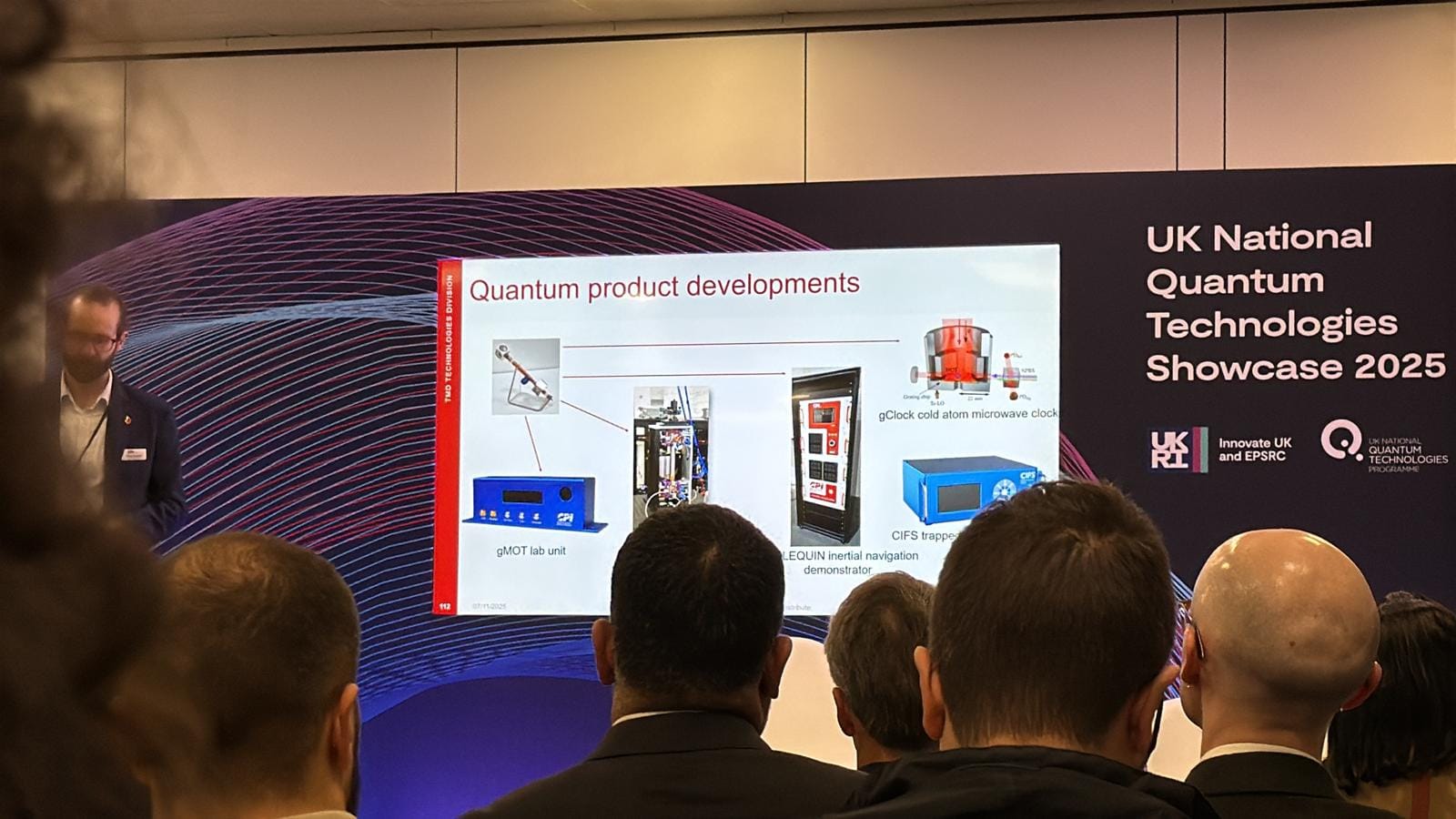
Why it’s notable: The HARLEQUIN architecture matches what Covesion and CPI TMD describe publicly—gMOT atom interferometer + RLG + clock—and it’s exactly the kind of hybrid approach you want for long holdover rather than pure dead‑reckoning drift.
Aquark’s Mini Cold‑Atom Clocks For The Telecom Edge
Aquark’s COO walked through a decade‑long miniaturization journey—culminating in AQlock devices and a Clock‑2 / AQlock 2 program aimed at base‑station/edge timing.
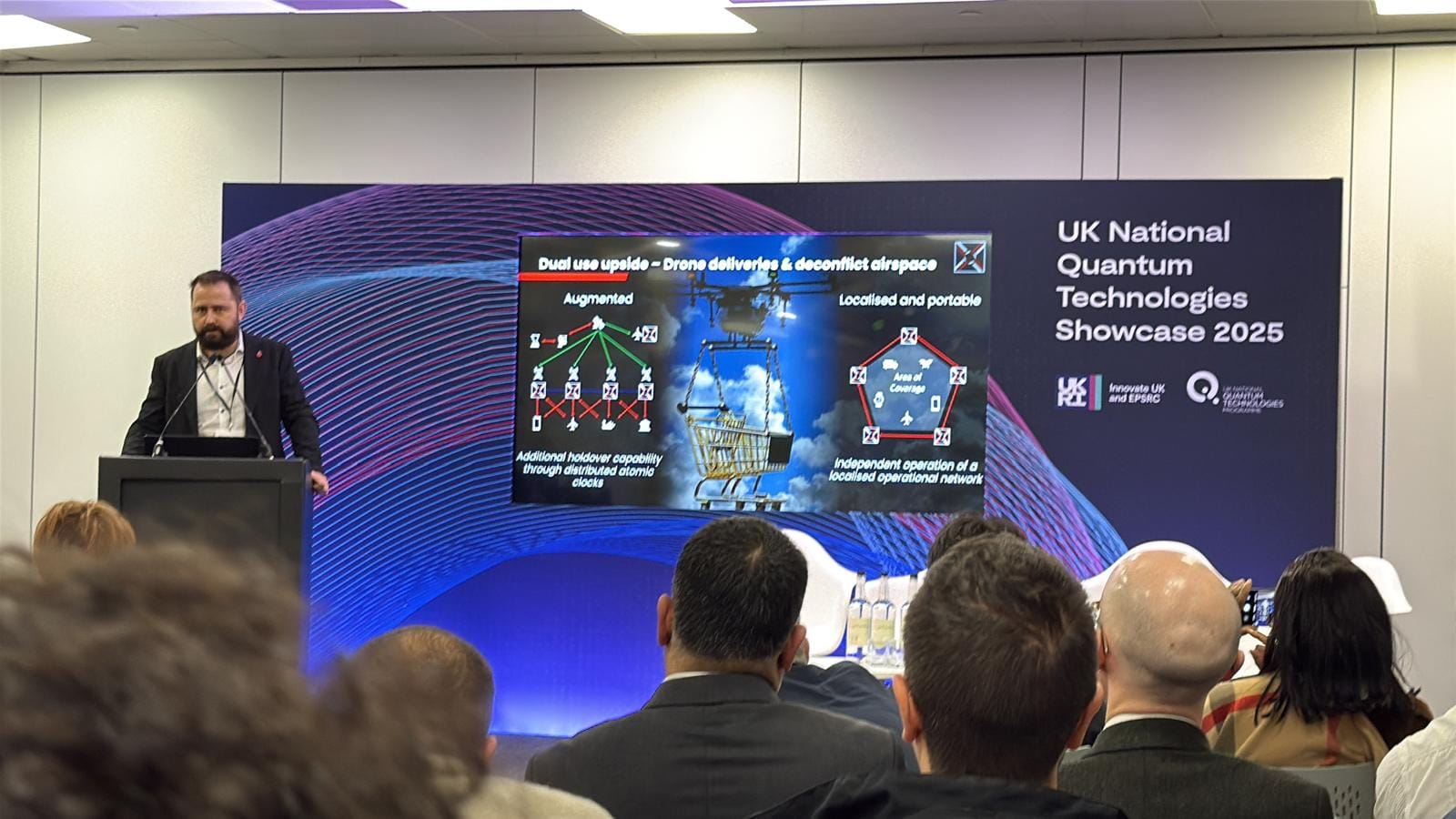
Two details stood out:
- “Super‑molasses” cooling (no applied magnetic fields) simplifies control and aids ruggedisation.
- Sea trials with the Royal Navy: the clock was run underway for days, validating stability in open water. The company announced a new Innovate UK contract for AQlock 2 on the day of the Showcase.
Why it’s notable: Cold‑atom clocks used to be lab monsters; seeing pocket‑ish packages heading for telecom edge timing is a big step toward GNSS‑resilient networks.
Solid‑state timing via SiC masers (Durham/Nascent & partners)
The other path to resilient timing avoids vacuums entirely: spin‑defect masers in silicon carbide. The talk covered ODMR spin physics, dielectric resonators, and self‑cal schemes around hyperfine features—plus the brutal reality that packaging and environmental hardening dominate the risk budget. Two programmes anchor the effort: QS‑EXACTand Q‑ASSET, the latter named in last week’s Contracts for Innovation winners.
Why it’s notable: If stability targets hold, SiC maser clocks could offer low‑SWaP holdover in places where cold‑atom lifecycle costs are hard to justify.
A MagNAV product you can hold a ruler to
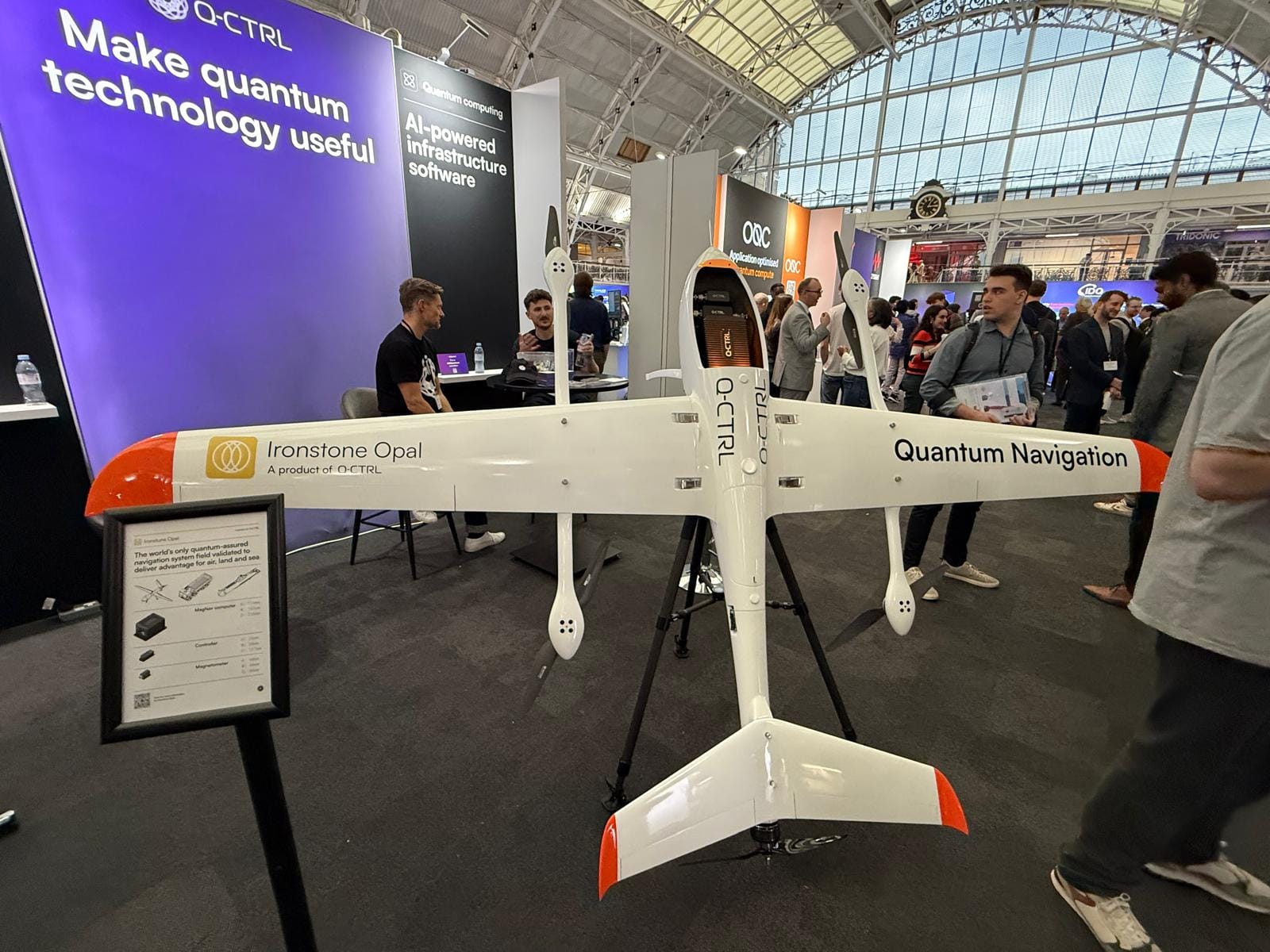
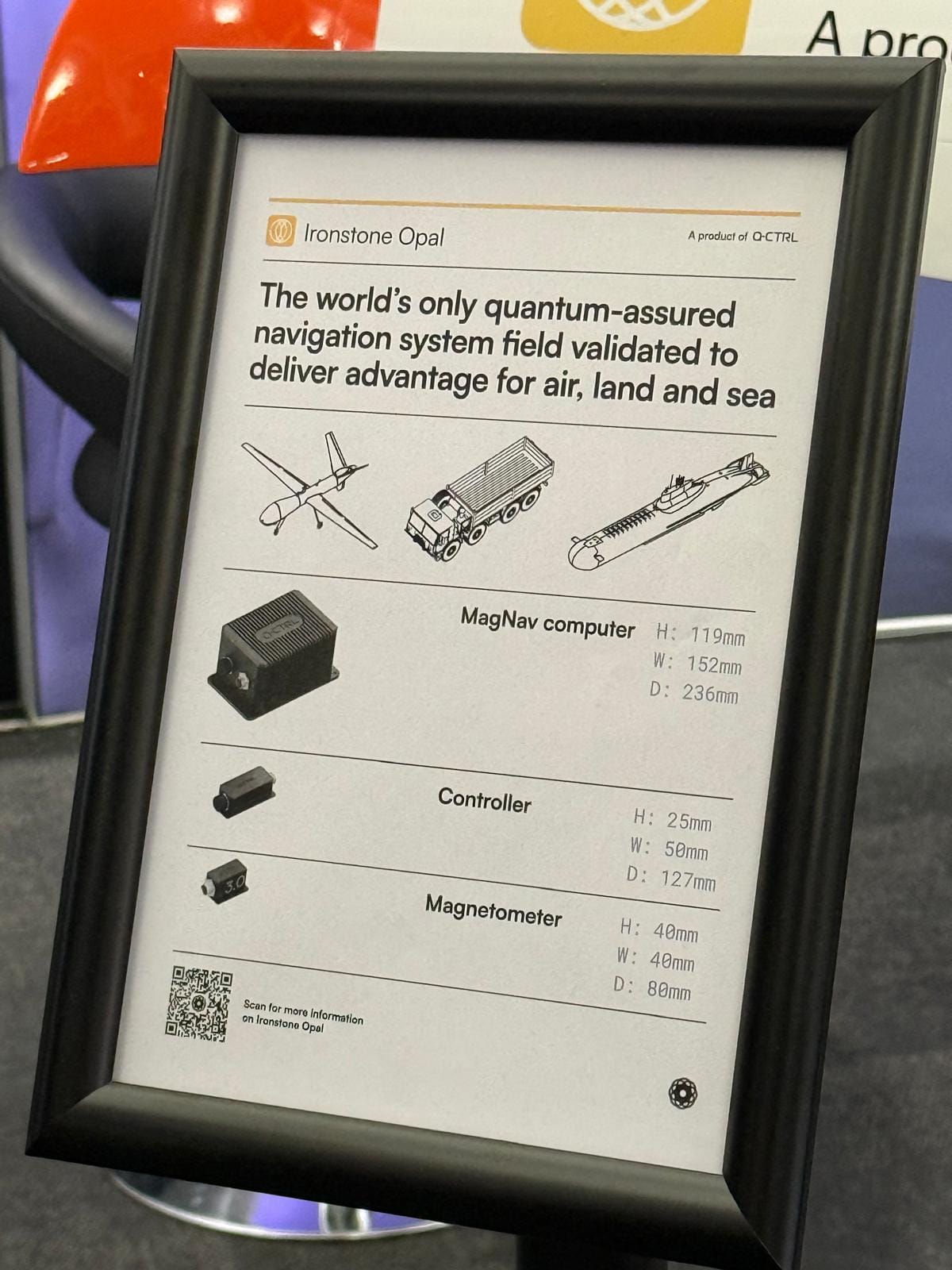
At the Q‑CTRL booth, their Ironstone Opal MagNAV pitch was ront‑and‑centre. One poster (photo below) bills it as “the world’s only quantum‑assured navigation system… for air, land and sea” and even lists the MagNAV computer dimensions: H 119 mm × W 152 mm × D 236 mm. That’s the sort of footprint an integrator can actually plan around. Q‑CTRL has also been public about Ironstone Opal’s aim—navigation resilience when GPS is degraded or attacked.
Quantum Networking: connecting processors & hardening the plumbing
Packaging entangled‑photon sources (EPS) for real‑world networks
One talk drilled into the unsexy but decisive work of packaging: hybrid photonic integration, 3D die‑stacking, thermal control for SPDC waveguides, and cryogenic compatibility for detectors—so EPS modules can survive space and defence environments and be bought more than once. That aligns with QNET‑EPS, an Innovate UK project led by Lumino with Alter Technology, Redwave Labs, Vodafone and Heriot‑Watt, targeting a sovereign UK EPS supply chain.
Why it’s notable: After years of heroic demos, networks need plug‑and‑play EPS bricks with yields, spares and datasheets—not just papers.
Nu Quantum’s HyperIon: qubit‑photon interfaces for modular QC
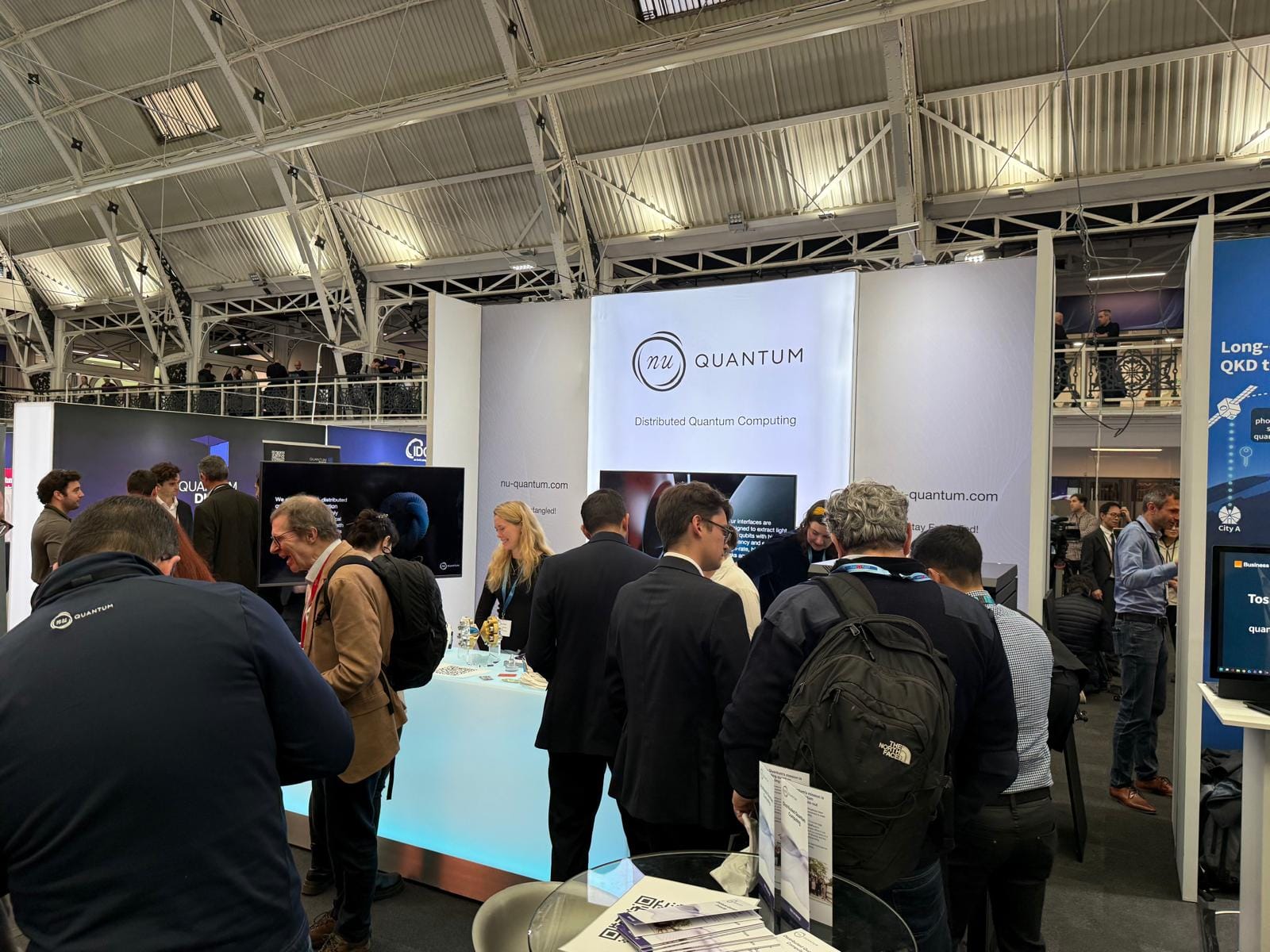
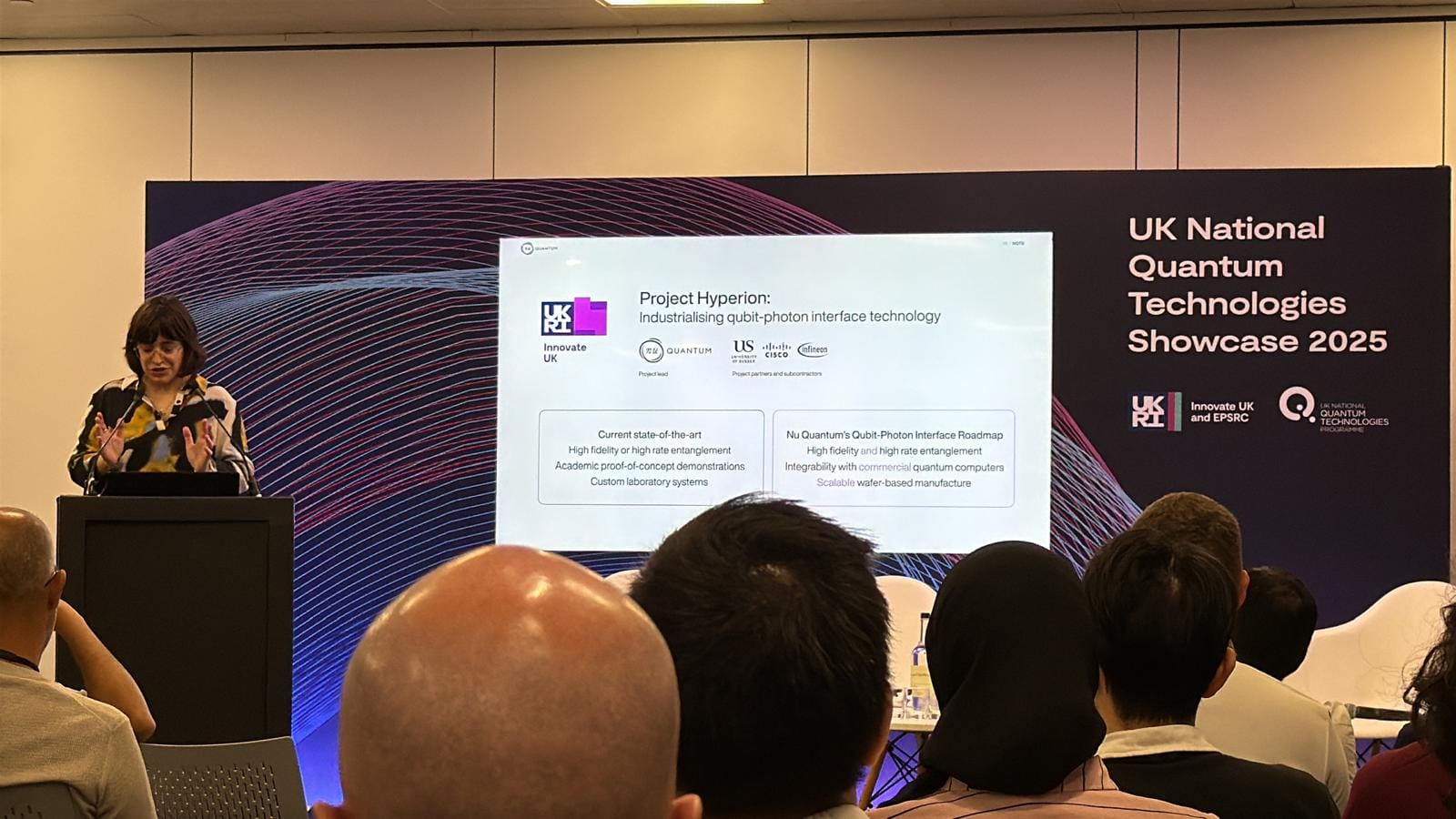
Nu Quantum laid out a simple truth: we will scale quantum computing the same way we scaled classical HPC—by networking. Their HyperIon project, with the University of Sussex, Cisco and Infineon, focuses on cavity‑enhanced ion‑photon interfaces that boost photon collection rate without wrecking fidelity, and—crucially—are integrable into real QPUs instead of living forever on optical tables. The roadmap includes foundry‑compliant designs for manufacturability.
Why it’s notable: Efficient, robust QPI hardware is the keystone for distributed machines—entangling qubits across chips and, ultimately, across racks.
KETS: chip‑based QKD that fits the telco world
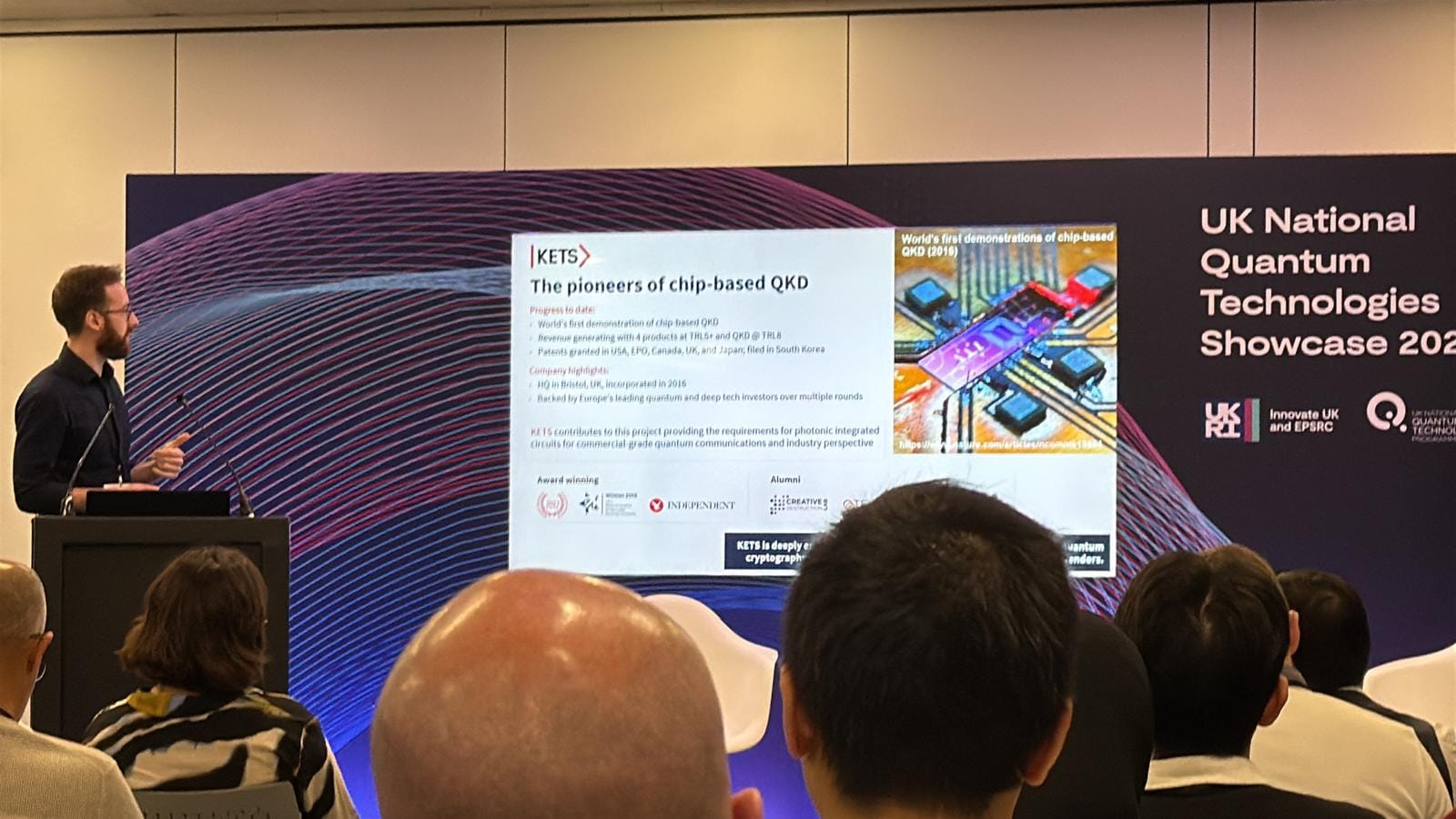
On the security side, KETS Quantum Security had a clear message—chip‑based QKD/QRNG for telecom environments. This year the company completed a £1.7 m SBRI project co‑developing a telecom‑grade QKD prototype with BT, pushing toward scalable, rack‑friendly deployment.
The cryo plumbing that makes it work
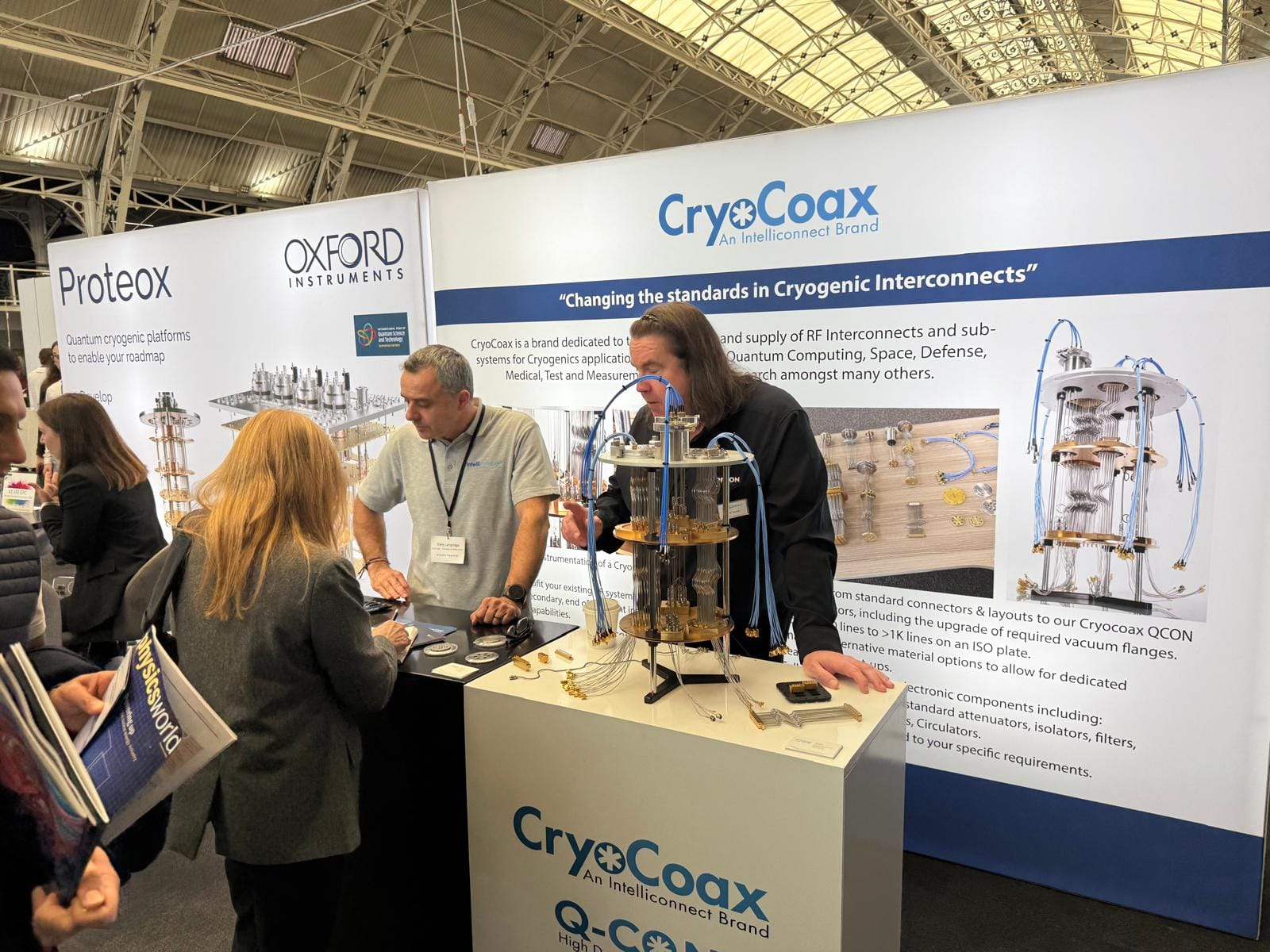
CryoCoax (Intelliconnect) showed off cryogenic RF interconnects—the cabling and connectors that quietly dictate whether a dilution fridge experiment is a one‑off or a product. If you’re building quantum hardware, these “boring” bits are often your schedule risk.
Sustainability sensing: quantum LiDAR for methane
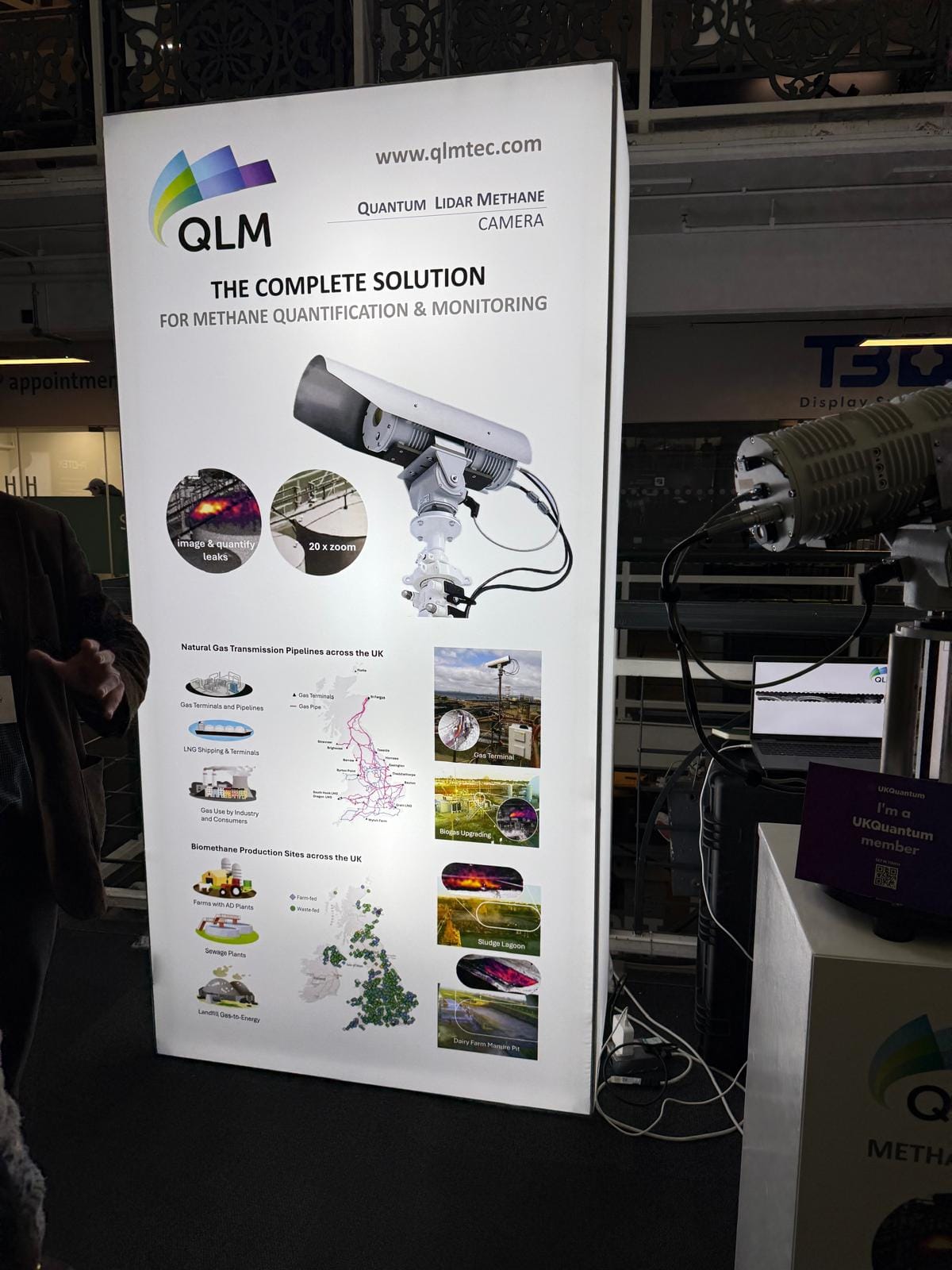
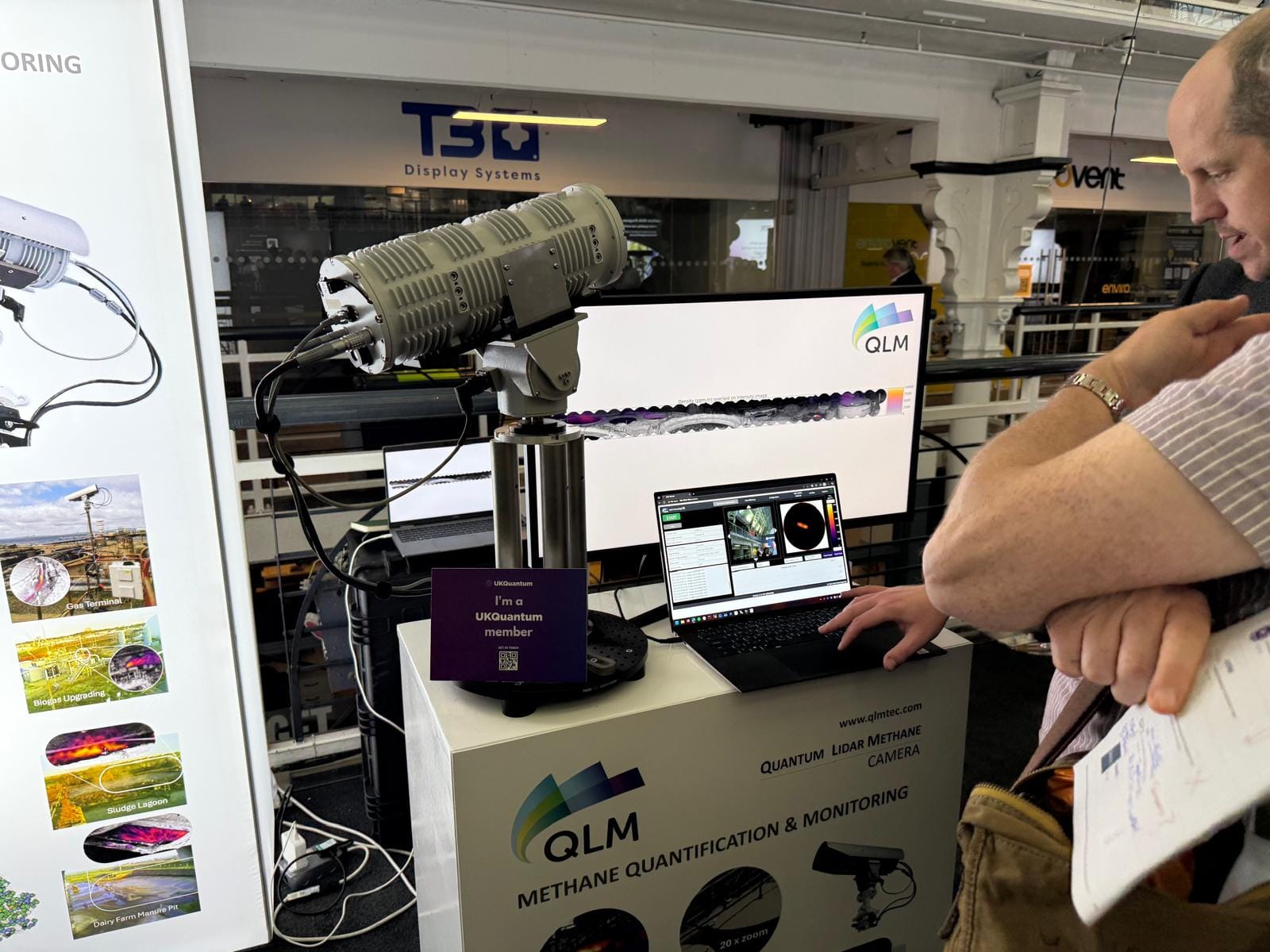
QLM Technology’s quantum LiDAR methane camera was one of my favourite “this helps tomorrow” demos—single‑photon detection, 3D imaging, and a cloud back‑end for continuous, autonomous emissions monitoring. Your photos show the camera and UK maps for pipelines and biomethane sites; their recent releases also highlight partnerships and regulatory pilots.
Who else I spotted
- IonQ had a presence (tagline: “Bringing useful quantum computing to the world”), consistent with the company’s stepped‑up UK activity following the Oxford Ionics acquisition. 
- Catapult signage reminded me how much UKRI family support is now pointed at commercialisation and supply‑chain gaps.
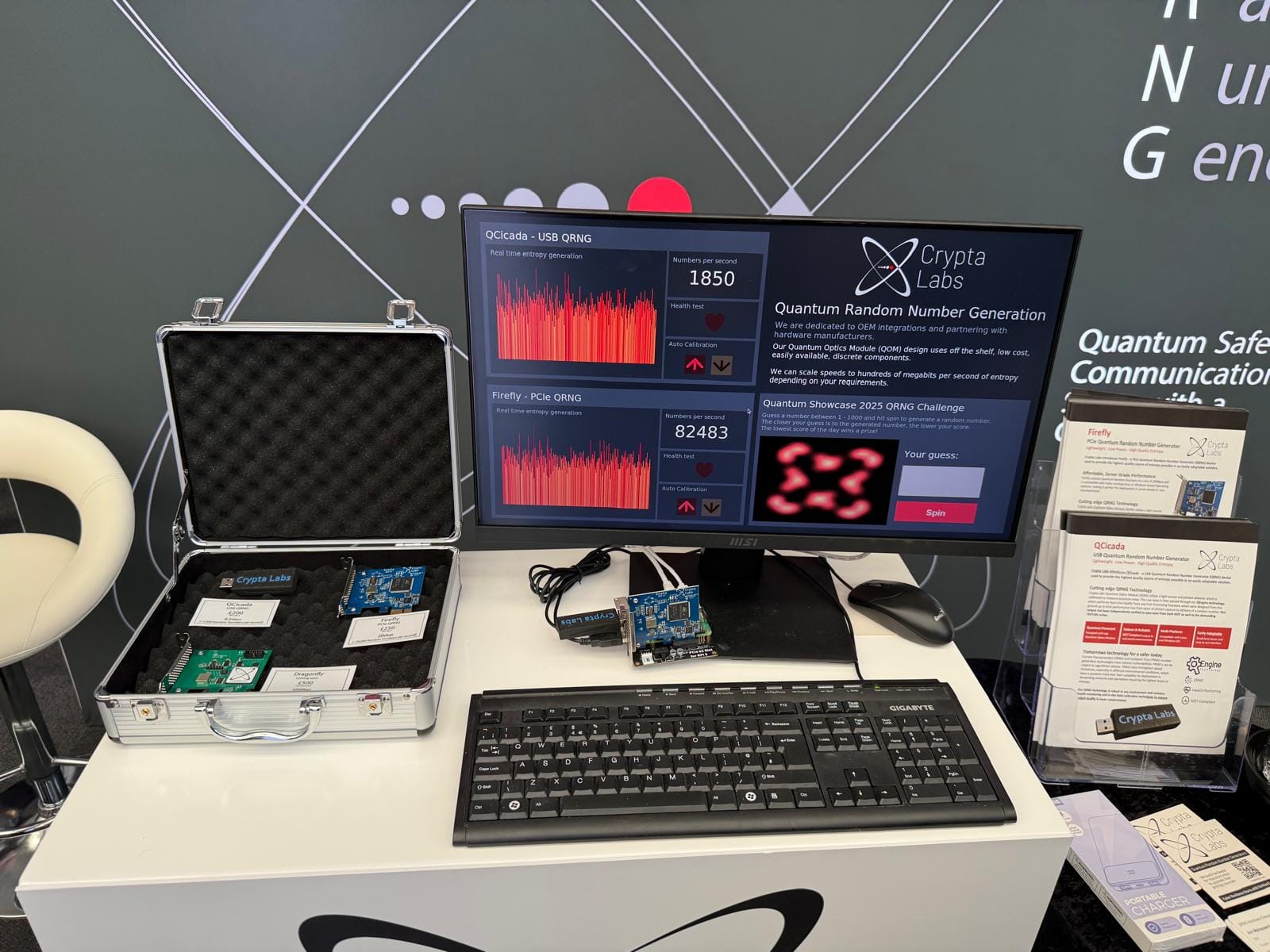
- Crypta Labs demoed two QRNGs—the QCicada (USB) and Firefly (PCIe)—plus a fun “QRNG challenge” at their stand.
Session takeaways
- Quantum navigation is going hybrid. Cold‑atom accelerometers are being added to proven classical sensors (ring‑laser gyros, clocks) to deliver longer holdover when GNSS is down. You buy a system, not just a sensor head.
- There’s a race between two clock families.
- Mini cold‑atom clocks (Aquark) are proving they can run on ships and, soon, at 5G/6G edges.
- Solid‑state SiC maser clocks (Nascent/Durham) aim for pocketable, low‑SWaP timing with no vacuum at all.The UK is funding both—which is smart, because their strengths land in different places.
- Networking is about engineering maturity. Entanglement sources, detectors and qubit‑photon interfaces are being re‑designed for manufacture and integration—think plug‑in EPS modules and cavity chips that live inside the QPU vacuum stack.
Explainers
What’s a gMOT?
A grating magneto‑optical trap uses micro‑fabricated diffraction gratings to turn one laser beam into the six beams needed to trap and cool atoms—shrinking the optics and easing alignment. Great for deployable interferometers on moving platforms. (See HARLEQUIN‑ST notes.)
Why does edge timing matter?
Even short GNSS outages desynchronise base‑stations, data‑centres and power grids. Local, high‑quality clocks make those systems resilient—and they unlock clever things, like RF‑based navigation as a fallback when satellites are jammed.
What is a qubit‑photon interface (QPI)?
A device that ties a material qubit (e.g., an ion) to a single photon so separate processors can entangle and compute together over fibre—just like classical clusters do over Ethernet, but with quantum states.
My three biggest “engineer brain” moments
- Dimensioned hardware, at last. When a poster gives me 119×152×236 mm for a MagNAV computer, we’re not in science‑fair mode anymore—we’re in CAD.!
- Trials beat slides. Aquark’s sea trials are the right way to burn down risk; vibration and temperature are merciless mentors.
- Packaging is product. The networking session was full of hybrid integration, thermal expansions and cryo constraints. That’s where the quantum internet gets real.
Where this leaves us
- PNT: Keep tracking hybrid navigation stacks (quantum + classical) and edge‑timing clocks. The UK just funded another wave of projects (Contracts for Innovation, Nov 11), which will accelerate prototypes into fieldable gear.
- Networking: Expect more EPS packaging announcements and QPI prototype integrations over the next 12 months. The focus will shift from demos to repeatability and yield.
- Sensing: Quantum LiDAR, gravimetry and magnetometry are maturing fastest where they solve painful, regulated problems (emissions, infrastructure resilience).