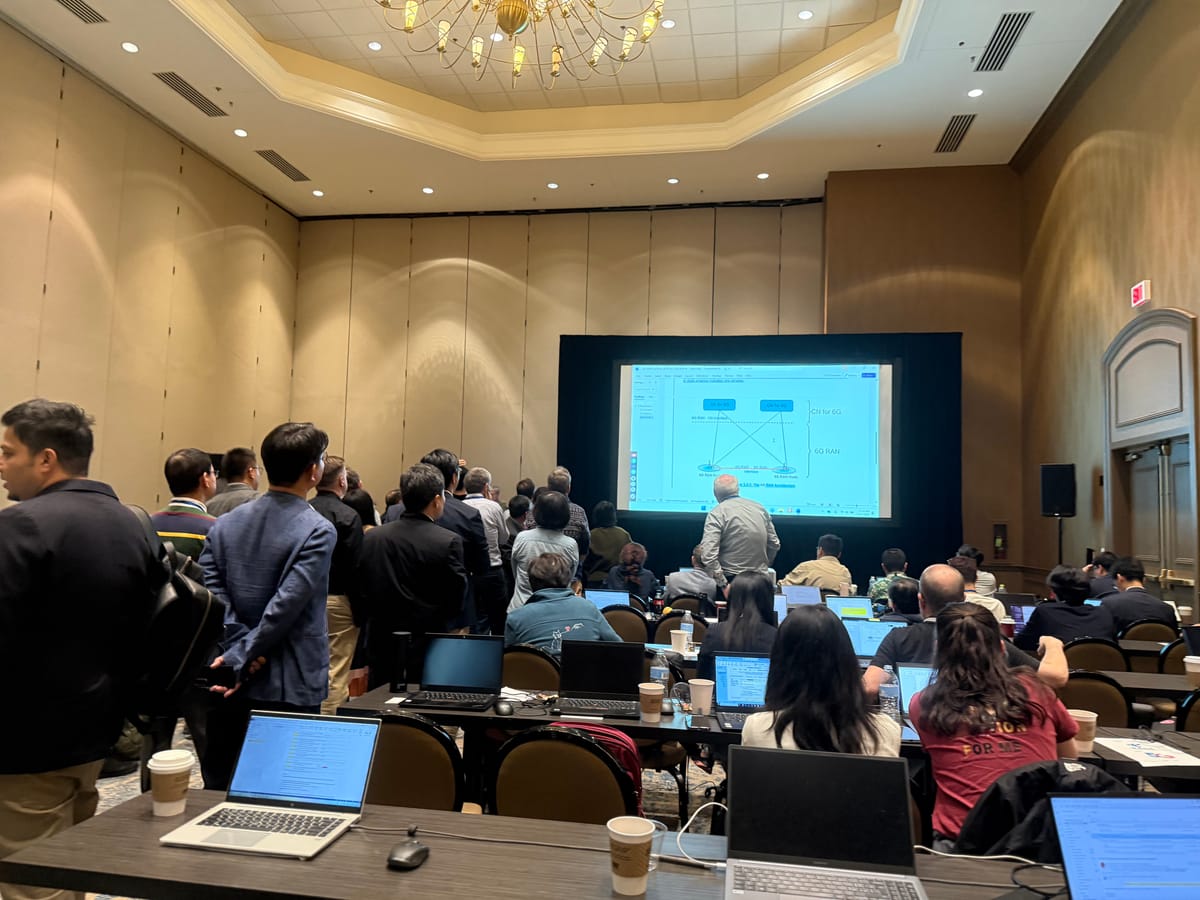
RAN3 #130 (Dallas, 17–21 Nov 2025): Rel-19 corrections surge (LTM, SON/MDT, AI/ML), plus 6G study-track checkpoints
RAN3 #130 was dominated by R-19 “essential corrections” work: LTM/mobility cleanups, Continuous MDT hooks, and AI/ML-for-NG-RAN alignment across Xn/F1/E1 and Stage-2 text. AIoT and energy saving also advanced via targeted NGAP/XnAP/F1AP fixes, while 6G study items stayed in architecture framing.
TL;DR
- RAN3 #130 was a consolidation meeting, with most effort directed at stabilising Rel-19 specifications rather than introducing new functionality.
- The main technical workload covered mobility and LTM enhancements, SON/MDT Phase 5, AI/ML for NG-RAN Phase 3, Ambient IoT Phase 2, and network energy saving.
- Cross-interface consistency (Xn, F1, E1, and NG) and Stage-2/Stage-3 alignment were recurring themes.
- 6G work remained in the study phase, focusing on architecture and principles rather than protocol text.
1. Introduction
RAN3 #130 took place in Dallas from 17 to 21 November 2025. The meeting marked a clear transition into a late-Rel-19 phase, where the emphasis shifted from feature definition to technical refinement, error correction, and consistency across specifications.
From a reporting perspective, the week was characterised by methodical convergence: issues that had accumulated over previous meetings were systematically resolved, while genuinely open questions were clearly identified for further work.
2. Overall meeting character
The meeting was dominated by corrective and alignment work. Contributions largely confirmed agreed technical directions, clarified ambiguous text, or corrected inconsistencies between related specifications. Only a limited number of items required substantive architectural debate, reflecting the maturity of the Rel-19 feature set.
This pattern is typical of a stabilisation phase: signalling behaviour was tightened, edge cases were addressed, and wording was adjusted to avoid divergent interpretations by implementers.
3. Rel-19 mobility and LTM enhancements
Mobility enhancements, and in particular Long-Term Mobility (LTM), formed one of the largest bodies of work during RAN3 #130. Discussion centred on refining existing procedures rather than creating new ones.
A visible theme was removal of edge-case ambiguity in inter-CU LTM signalling, including missing or inconsistent indicators and measurement-related transfers (e.g., R3-258153, R3-258045, R3-258046). The meeting also progressed corrective work on stability and recovery behaviour around LTM, including failure handling and reset-related procedure detail (e.g., R3-258026, R3-258317).
Not everything was closed out. The week also surfaced and documented residual topics that need further convergence, including early RACH requester identity handling and remaining inter-CU LTM procedure details (e.g., R3-258151 (Noted), R3-258665 (Noted)). Liaison-driven alignment on L2 reset aspects of LTM also continued to be tracked (e.g., R3-258006 (Noted)).
4. SON/MDT Phase 5 and Continuous MDT
Self-Organising Networks (SON) and Minimisation of Drive Tests (MDT) continued to be a major focus. RAN3 #130 advanced MDT Phase 5, including signalling support for Continuous, management-based MDT.
Concrete progress was made on protocol support for Continuous MDT and Continuous Management-based MDT across relevant interfaces, covering both procedure behaviour and information element handling (e.g., R3-258433, R3-258685, R3-258216, R3-258458).
Cross-group coordination featured prominently in the MDT track, particularly where scoping and terminology needed to be aligned across WGs. This included work on geographical-area scoping and continuous reporting framing, handled through liaison activity and its follow-up (e.g., R3-258005 (Noted), R3-258651 (Approved-unseen), R3-258475 (Approved)).
5. AI/ML for NG-RAN Phase 3
AI/ML for NG-RAN Phase 3 work progressed primarily through targeted corrections and clarification of existing mechanisms. The meeting focused on keeping Stage-2 architectural descriptions aligned with Stage-3 signalling specifications across E1AP, F1AP, and XnAP.
In several cases, discussion confirmed that existing signalling already supports the intended AI/ML behaviours, making additional protocol extensions unnecessary. Where specification text left room for interpretation, corrective changes were agreed to remove ambiguity while preserving backward compatibility, including bundles of miscellaneous corrections and interface-specific clean-up (e.g., R3-258028, R3-258032, R3-258064, R3-258029 (Agreed-unseen)).
The meeting also handled definition-level alignment where AI/ML concepts intersect with other feature areas and must be interpreted consistently (e.g., R3-258479 (Approved-unseen)).
6. Ambient IoT Phase 2
Ambient IoT Phase 2 continued to mature at RAN3 #130. Work covered both functional signalling aspects and security-related considerations.
Functional work tightened procedure text and message semantics and progressed interface management aspects intended to reduce ambiguity for implementers (e.g., R3-258052, R3-258053, R3-258051). On the security side, the meeting advanced corrective work on Ambient IoT security information handling and related integration aspects (e.g., R3-258338).
Identifier and encoding detail also received attention, reflecting the need for precise and interoperable handling in this feature set. This included convergence on identifier/encoding aspects (e.g., R3-258595 (Approved)) and related identity handling (e.g., R3-258123 (Endorsed-unseen)).
7. Network energy saving
Network energy saving remained an active topic, with particular attention on signalling support for on-demand system information and the operational lifecycle of OD-SIB1.
The meeting progressed corrections spanning coordination support, termination/status handling, and interface support for network energy saving enhancements (e.g., R3-258054, R3-258055, R3-258302 (Agreed-unseen), R3-258453 (Agreed-unseen), R3-258503 (Agreed-unseen)).
A noticeable portion of the effort was spent on “spec hygiene” issues that can otherwise create interoperability risk in implementation, including reference consistency and criticality handling for OD-SIB1-related procedures (e.g., R3-258171 (Merged), R3-258280 (Merged)).
8. Inter-group coordination
A number of topics required close coordination with other 3GPP groups. These included mobility-related reset behaviour, emergency service interactions, non-terrestrial network considerations, public warning system alignment, and transport security topics.
During the meeting, dependencies on other groups’ work were clearly identified and respected. RAN3 avoided duplicating responsibilities while ensuring that its own specifications remain consistent with system-level decisions taken elsewhere.
9. Coordination breaks
Several coordination breaks were used during the week to accelerate convergence on complex or cross-cutting topics, including mobility enhancements, SON/MDT, AI/ML for NG-RAN, and Ambient IoT security.
These focused sessions were effective in resolving detailed technical questions, reducing the backlog of open issues, and enabling agreement on multiple corrective changes within a single meeting.
10. 6G study work
6G-related discussions at RAN3 #130 remained firmly within the study phase, with the objective of shaping a coherent architectural baseline for future work rather than producing protocol specifications.
A central thread was the articulation and consolidation of early architectural principles and requirements, including how a 6G RAN architecture should balance flexibility, scalability, and interoperability without over-constraining implementation choices (e.g., R3-258232 (Agreed-unseen), R3-258567 (Agreed-unseen)). The meeting also progressed the RAN3 aspects of the 6G radio study, including an updated early baseline for the corresponding study report work (e.g., R3-258087 (Endorsed)).
On the RAN–CN boundary, discussion addressed interface and interaction options suitable for cloud-friendly deployments and long-term evolution. This included consideration of point-to-point versus alternative interaction styles and how those choices could be framed in a way that keeps later protocol decisions open while still enabling consistent architecture work (e.g., R3-258427 (Agreed), R3-258638 (Agreed-unseen)).
AI/ML was treated as a cross-cutting architectural topic in the 6G study, focusing on principles and use-case framing rather than defining concrete signalling mechanisms. The week advanced principles for the 6G RAN AI/ML use-case study work, aiming to identify the information and architectural hooks needed for AI/ML integration without embedding algorithm-specific assumptions (e.g., R3-258267 (Agreed-unseen)).
Mobility, interworking, and broader evolution topics were discussed at a conceptual level as part of the study framing, including how future requirements might stress today’s architectural assumptions and what design principles should guide evolution. Throughout the 6G sessions, a consistent theme was the deliberate separation between study conclusions and normative specification work. Protocol-level design and Stage-3 text were intentionally deferred, with the emphasis placed on building shared understanding and documenting architectural direction to guide subsequent phases of standardisation.
11. Conclusion
RAN3 #130 represented a clear consolidation milestone for Rel-19. The meeting prioritised essential corrections, improved cross-interface consistency, and removal of specification ambiguities, laying the groundwork for stable and interoperable implementations.
At the same time, RAN3 continued to advance 6G study work in a disciplined manner, focusing on architectural clarity without prematurely committing to protocol designs. Together, these outcomes position the group well for the next phase of both Rel-19 completion and longer-term 6G development.